OSE: Hole in the Oak - Session 2 Report
Previous session report can be found here. Next session report is here.
Overall
Yesterday, I ran the second session of my Hole in the Oak game via FoundryVTT. It was a three-hour session, and once again I’m surprised by how much more we can get done using OSE compared to running games in, say, PF2e. I’ve gotten more used to hosting the game on FoundryVTT as well. On top of that, the PCs were also on fire this session! It was wonderfully enjoyable all around.
What Went Well
Using FoundryVTT
This time, I’d checked the journal notes on FoundryVTT to see how it would work. While they did have all the relevant information, I found the PDF to be more easy to reference. So, I just stuck with the PDF on my second screen, and that worked just fine.
Running combat
This was also the first time I ran combat, and the mechanics in Foundry worked quite easily once I figured out I had to assign “teams” to the combatants. I was quite happy that I remembered a lesson that Hexed Press discussed in his corrections video. He pointed out that a lot of people will run combat in phases per team1 but the actual OSE rules have you run a turn first for one team and then the next. I had a quick glance at my rules reference next to me and made sure to follow that procedure.
Skills versus description
The PCs were also rocking it this session! I described a room where an illusory treasure is meant to tempt the players to cross a dangerous pit, which certainly tempted them. At first they figured to approach it like mountain climbers and hammer pins and ropes to the wall to ensure a safe passage. Then, just before they would do it, one PC had a great idea: pick up a rock and throw it at the treasure! It was so cool to describe the rock just falling into the treasure as though it hit a pond—image of the treasure wavering before settling down.
Similarly, a bit later there was a section of hallway with a set of waterlogged corpses. Of course, these were only really ghouls laying in wait pretending to be watery cadavers. Instead of moving forward, however, the players were very suspicious and started examining the corpses. They asked loads of questions about footprints, what direction the corpses were lying, and what their wounds were. Fully suspicious, they poked the lead corpse with a polearm, and when it reared up in pain, they threw a burning oil flask to the corner and ran! Awesome stuff!
It really drove home to me that using skills on the character sheet is a risky endeavor. Just a 1-in-6 to spot a trap? Yikes! However, a PC describing a sensible course of action has a 100% chance of success. It seems to suggest that the skills on the character sheet are a “when all else fails” type of solution.
Lessons Learned
Infravision
A thing I want to pay attention to next session is how to describe infravision. OSE describes infravision as enabling characters to “see heat tones”. Almost all the PCs have infravision, so they did not light any torches for a few turns (forcing their retainer to follow them in the dark!).2 I forgot the description of infravision quickly enough and without thought started treating it like perfect nightvision, describing things they could see.
When I caught myself, I just started verbalizing: “Hmm, how would you see that in heat tones? Let me think…” when they asked about descriptions of things. That prompted them to light torches to start looking at things more. For next time, I should probably put a sticky note on the monitor to remind myself of that procedure.
Loyalty rating
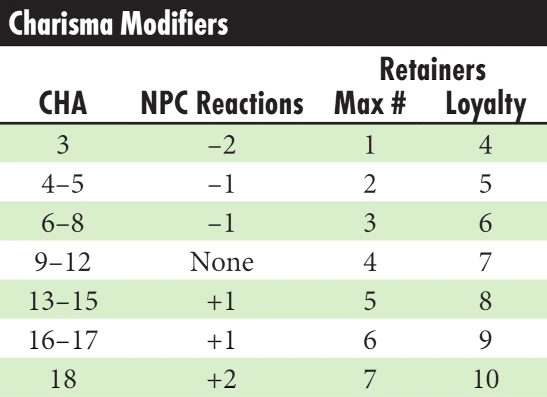
At the very start of the previous session, one of the retainers snuffed it falling down the hole into the dungeon. In this session, on returning to town, the PCs decided to sell off what they recovered of his gear and donate half of it to his widow and children. I thought that the other retainers seeing that would probably appreciate the gesture, and they should earn a little loyalty bonus.
And then I realized I didn’t really know what their loyalty bonus was! I did a bit of quick searching, but I couldn’t find an answer on the spot in a reasonable amount of time.3 Turns out that I shouldn’t have just skipped over the “Charisma Modifiers” table in my search, as all I needed was right there!
Town services
When the PCs made it back to town, they wanted to do exactly what you’d expect: sell off some old gear, get a room at an inn to heal, and prep for the next delve. While it was exactly what you’d expect, I hadn’t given it any thought, actually. I had a quick peek in the OSE manual but couldn’t find any helpful table, so I just made some stuff up. Selling items? Sure, at 50%! A room for the day? Umm, 1gp? Was there a mage in the village who could decipher scrolls? Nah! It’s a tiny village!
I just rolled with it, and it was fine. Afterwards, though, I delved through my copies of Carcass Crawler, and found that Carcass Crawler #2 had a little section on town services. It was pretty much what I just defaulted to, so that felt pretty validating. I hadn’t gone as far as specifying what food the inn served, as in the zine, but that also didn’t seem that pertinent at the time.
Listen checks
There’s a passage in the OSE rules that is a little confusing to me. The procedure notes specifically:
One chance: This attempt may only be made one time at any door by a character.
Strictly speaking, this would read as a character only ever being able to listen at doors once. However, it could mean that the intention is that only one character can listen at a specific door. The B/X rulebook, however, notes:
For each character listening, the DM should roll 1d6. […] Each character may only try once per door.
So, the original text is much clearer: everybody can listen at any door just once. On the one hand, I dislike the idea of an entire party all listening at a door for ten minutes (what a silly sight that would be!). On the other hand, I also cannot find a reasonable justification that a party should not be able to do exactly that. So, I guess I’ll continue to rule that everybody can listen at the door together.
-
That is to say: first everybody moves, then everybody shoots, etc. This contrasts to first one team does all its actions, then the next team. ↩︎
-
In retrospect, I should have that caused a loyalty penalty. Who would be happy following an employer in absolute dangerous darkness for half an hour? ↩︎
-
I keep a little one-minute sandtimer on my desk—if I can’t find a rule or answer in that time, I’ll just make something up. ↩︎
Your comments are welcome!